Choosing the Best Eco Friendly Food Packaging in 2026 means looking beyond labels. A paper bowl, molded-fiber tray, or compostable pouch can seem like an easy win. Yet each option depends on what it contains, how it travels, and where it ends up. That last step is often overlooked.
The OECD’s Global Plastics Outlook (2022) estimated that the world generated 353 million tonnes of plastic waste in 2019; only 9% was recycled. Packaging made up about 40% of that waste. These figures cover plastics broadly, not food packaging alone, so they provide context rather than a direct comparison of materials. Still, they show why packaging choices deserve close attention. The United Nations Environment Programme’s Turning off the Tap (2023) also calls for changes across the plastics system, including reuse, recycling, and alternatives. A material swap by itself is not enough.
This guide compares practical options for 2026, including recycled-content paperboard, molded fiber, reusable containers, and certified compostable materials. It considers barriers like grease, moisture, shelf life, transport, and local collection access. A crisp salad in a fiber bowl faces different needs from hot soup in transit. Small details matter. So does the disposal route. Eco Friendly Food Packaging is not automatically better because it looks natural or carries a green claim. The best choice depends on credible evidence and local infrastructure—and sometimes the honest answer is that no option is perfect.
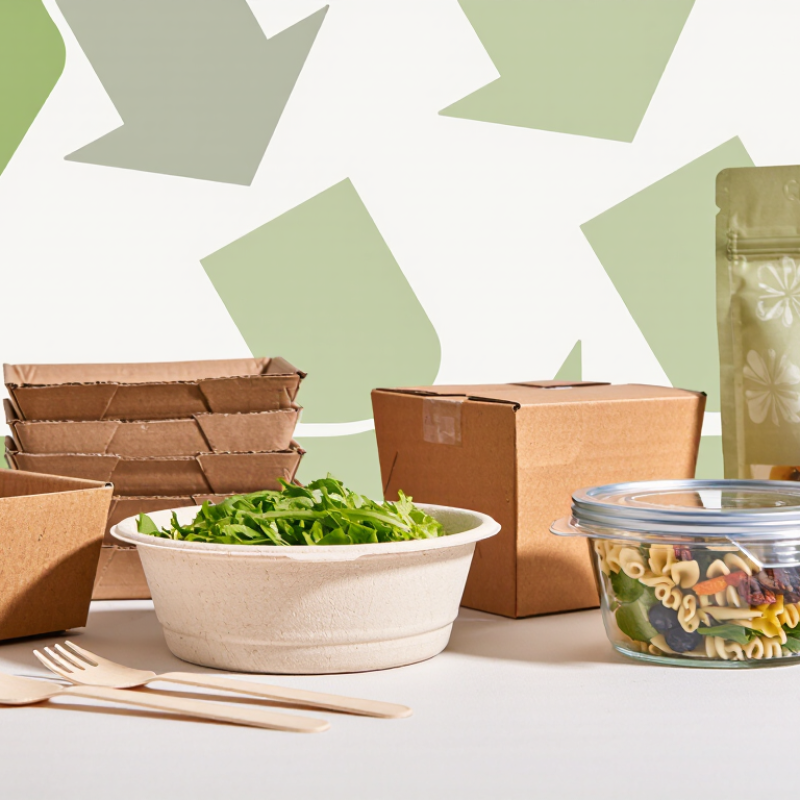
How Eco-Friendly Food Packaging Is Defined and Evaluated in 2026
In 2026, “eco-friendly” should describe measured performance across a package’s life, not just its material or marketing label. ISO 14040 and 14044 life-cycle assessment standards compare impacts from raw-material extraction through manufacture, transport, use, and disposal. For food packaging, the assessment must also consider product protection: a thin fiber tray that lets produce spoil may shift the burden from packaging to wasted food. UNEP’s 2023 report Turning off the Tap estimates packaging represents 36% of plastics produced worldwide. The OECD’s Global Plastics Outlook (2022) reports that packaging accounts for 40% of plastic waste. Different measures, same signal. Packaging choices matter.
A sound evaluation combines material use and emissions with food protection and realistic local recovery options. Ask what the study measures and which assumptions it uses. Was the comparison based on one meal delivered intact, or one empty container? That matters. Check whether “compostable” means home composting or industrial processing, and whether local facilities accept the item. A paper bowl with a plastic lining may look simple, yet that layer can complicate sorting. Reusable containers can perform well, but only with enough reuse cycles and efficient washing. The awkward part: no option wins everywhere. A credible claim explains its conditions, cites its data, and acknowledges uncertainty.
Best Eco Friendly Food Packaging Types in 2026? - How Eco-Friendly Food Packaging Is Defined and Evaluated in 2026
| Packaging type | Best suited for | Potential environmental strengths | End-of-life reality | Key trade-offs | What to evaluate in 2026 |
|---|---|---|---|---|---|
| Reusable containers | Food-service takeout, meal delivery, and closed-loop settings with return points | Can avoid repeated single-use packaging when containers are returned and reused many times. | Requires a practical collection, washing, inspection, and redistribution system. Damaged containers need an appropriate recovery route. | Transport and washing use resources; benefits depend on return rates, container durability, and the number of completed reuse cycles. | Measure actual reuse cycles, return rate, loss and breakage, washing impacts, and distance traveled. Compare with the single-use option for the same use. |
| Recycled or recyclable paper and board | Dry foods, cartons, sleeves, bags, and secondary packaging | Paper fibers can be recycled where collection and processing systems accept the item. Recycled fiber content can reduce demand for virgin fiber. | Clean, uncoated paper is commonly recyclable in paper streams. Food residue, plastic liners, grease barriers, and some coatings can limit recovery. | Paper may need more material or a barrier to resist moisture and grease. A paper appearance does not guarantee recyclability. | Check verified recycled content, fiber sourcing, barrier composition, food-contact compliance, and acceptance by the intended local paper-recycling system. |
| Molded fiber and bagasse | Trays, bowls, clamshells, and protective inserts | Can use recycled paper fiber or plant-processing residues such as sugarcane bagasse. Fiber-based formats may be recyclable or compostable depending on their design and local facilities. | Food residue, coatings, and additives affect sorting and processing. Compostability should not be assumed from the feedstock alone. | Heat, water, grease, and leak resistance may require coatings or liners that complicate recovery. | Request the full material composition and evidence for the claimed disposal route. Confirm local acceptance and test performance for the actual food and use conditions. |
| Mono-material recyclable plastic | Clear food trays, bottles, tubs, and other applications needing moisture or product protection | Designs made from a single commonly collected resin can be easier to sort and recycle than mixed-material packaging. Recycled content may reduce use of virgin plastic where suitable and permitted. | Recyclability depends on resin, color, labels, closures, food contamination, sorting equipment, and local collection rules. Technical recyclability does not guarantee actual recycling. | Plastic can persist as litter if mismanaged. Food-contact and performance needs can restrict recycled content in some applications. | Identify the resin and every component; check local acceptance, actual recycled-content documentation, food-contact requirements, and whether the package is collected and sorted in the target market. |
| Aluminum packaging | Beverage cans, trays, foil, and applications requiring a strong barrier to light, oxygen, or moisture | Aluminum can be recycled repeatedly when collected and processed. Recycling aluminum generally uses substantially less energy than producing primary aluminum from ore. | Recovery varies by local collection systems and package design. Small or heavily contaminated items may be missed or rejected. | Primary aluminum production is energy-intensive, and lightweight foil or laminated formats may be difficult to recover. | Check recycled content, package weight, component separation, local collection access, and whether coatings or attached materials affect sorting. |
| Glass containers | Beverages, sauces, jars, and products needing a strong, inert barrier | Glass is widely recyclable in some regions and can be reused where a suitable return system exists. It provides a strong barrier and does not readily absorb food flavors. | Collection and color-sorting systems vary. Reuse requires return logistics, washing, and containers designed to withstand repeated handling. | Glass is heavy and fragile, which can increase transport impacts and breakage risk compared with lighter formats. | Compare transport distance and weight, recycled content, local glass collection, breakage rates, and—if reusable—the number of successful return cycles. |
| Certified compostable packaging | Selected food-service applications where food scraps and packaging can be collected together for accepted composting | Can be useful in a managed organics system when the package is certified for the intended composting conditions and accepted by the facility. | Many products require industrial composting conditions. They generally should not be assumed suitable for home composting, recycling, or ordinary landfill disposal. | Composting access is limited in many areas. Compostable items can contaminate recycling streams if incorrectly sorted. | Verify the exact product certification and scope, such as ASTM D6400 or EN 13432 where relevant; confirm the local facility accepts it and provide clear disposal instructions. |
Evaluation principle: “Eco-friendly” is not a single material property. Compare packaging that protects the same food and serves the same function, considering material quantity, sourcing, production, transport, food loss, reuse, and the disposal infrastructure actually available to the user.
FAQS
Paperboard and cardboard can suit dry snacks, bakery items, and takeaway cartons. Sturdy folds help protect corners during delivery.
It can hold its shape, but grease and steam may weaken it. Test a warm sample before ordering in bulk.
A ventilated container can release steam and help protect the crust. A tightly sealed box may make it soft.
Choose a leak-resistant container with a secure lid. Test it while warm, since cold testing may miss problems.
Not necessarily. Some need controlled industrial composting conditions, so check whether local facilities accept them.
No. Check local collection guidance, and consider food residue, coatings, lids, and mixed materials.
Look for documentation covering the food type, temperature, and contact time. A container suited to cold fruit may not suit hot soup.
Pack a sample meal for the usual delivery time. Check for leaks, sogginess, heat loss, stacking, and awkward opening. Small details matter.
Not always. Their durability can help when containers are reused or efficiently recycled, but weight and production impacts still count.
No. Check which parts the claim covers and whether nearby composting services accept them. Labels can be confusing.
Conclusion
Eco Friendly Food Packaging in 2026 is best understood as packaging that balances responsible material use with practical performance across its life cycle. Evaluating it means looking beyond labels to consider how materials are sourced, how much protection they provide, whether they can be reused or processed after use, and what environmental impacts may arise from production and disposal. Common options include paper and cardboard, molded fiber, plant-based materials, and recyclable plastics, each with different strengths, costs, and end-of-life considerations.
The right choice depends on the food and service needs: liquids, hot meals, greasy foods, and takeaway items may require different levels of moisture, heat, or leak protection. Buyers should compare packaging options by food safety, durability, cost, and local disposal access. They should also verify compostability and recyclability claims against clear product details and available facilities, rather than assuming that a material will be accepted everywhere.