Choosing a supplier for Compostable Food Packaging takes more than comparing prices or browsing attractive product photos. Buyers need to examine materials, product performance, documentation, and the composting conditions each item requires. A bowl that holds hot soup may behave differently from a thin takeaway lid. Details matter.
This guide introduces ten suppliers serving markets around the world and outlines what businesses should check before requesting samples. Product ranges may include molded fiber trays, paper cups, compostable bags, and food-service containers. Availability and shipping options can vary by region, so a supplier’s global reach does not guarantee local stock. That distinction matters.
Compostable claims also deserve careful review. Ask for current certificates and confirm which products they cover. Check whether an item is designed for industrial composting, home composting, or another specified process. Local facilities may not accept every certified product. A label alone is not enough.
Real-world trials help reveal what a brochure cannot: whether a container leaks, softens, or stacks neatly during a busy service. Request samples and test them with the foods, temperatures, and handling conditions your team actually uses. Compare minimum order quantities, customization, lead times, and technical support as well. No supplier is perfect. This shortlist is a starting point, not a substitute for due diligence. The right choice depends on your product, customers, and waste-management options.
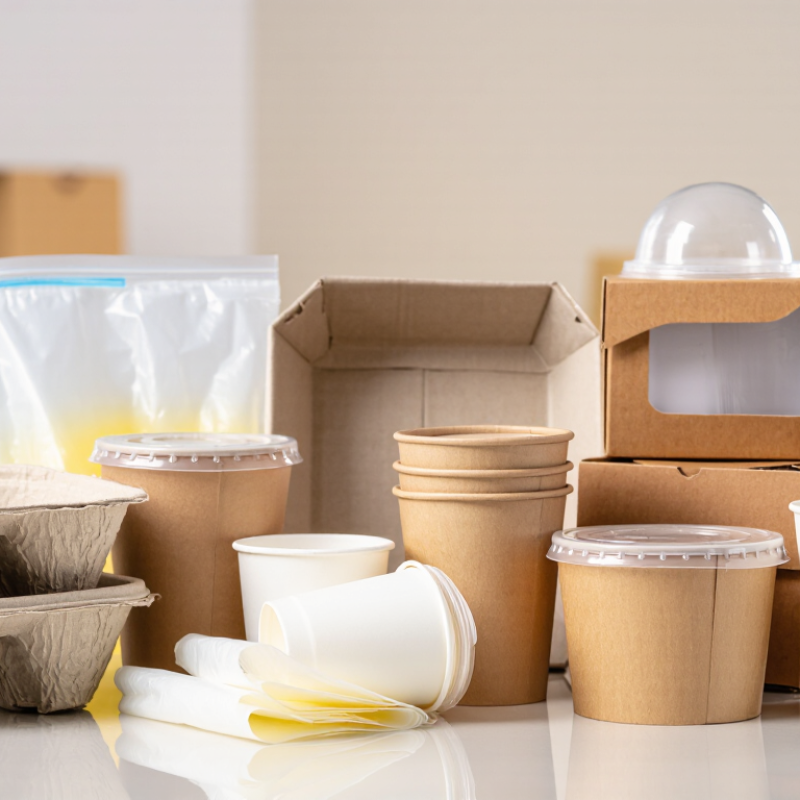
What Compostable Food Packaging Is and How It Works
Compostable food packaging is designed to break down through biological activity under suitable conditions. It may be made from plant-based materials, paper fibers, or other compostable polymers. Unlike conventional plastic, it should become simpler organic matter in a managed composting environment. The process needs the right balance of heat, moisture, oxygen, and microorganisms. Not magic. A package may need weeks or months, depending on its material and local facility.
Industrial composting facilities control temperature and airflow to help materials decompose. Home compost piles are less consistent and may not reach the same heat. So a package labeled compostable in one setting may not break down well in another. The wording on the label matters. Check whether it specifies home or industrial composting, and follow local collection guidance.
In a busy kitchen, a wet takeaway bowl with food scraps can look ready for compost, but appearance does not prove it will decompose properly. Some facilities ask users to remove lids or food residue; others have different rules. Contamination can also make a whole batch harder to process. It is easy to overpromise what packaging can do. Compostability helps only when the material, disposal route, and facility work together. That part is often overlooked.
Top 10 Compostable Food Packaging Suppliers Worldwide - What Compostable Food Packaging Is and How It Works
This comparison covers ten widely used supplier categories rather than ranked or named companies. Compostability depends on the finished product, its certification, and the disposal conditions; a material described as compostable is not necessarily suitable for home composting.
| No. | Supplier Category | Typical Packaging | Common Material | How It Works | Important Consideration |
|---|---|---|---|---|---|
| 1 | Molded-fiber packaging suppliers | Trays, bowls, clamshells, and protective inserts | Bagasse, recycled paper fiber, or other plant fibers | Wet fibers are formed in a mold, then pressed and dried into a rigid shape. The fiber structure can break down under suitable composting conditions. | Water- or grease-resistant coatings and additives may affect compostability; check the finished item’s certification. |
| 2 | Paperboard packaging suppliers | Food cartons, cups, sleeves, and takeaway boxes | Paperboard with a compostable barrier or lining, where certified | The board provides structure; a thin barrier layer can help resist moisture or grease. Compostability applies to the complete construction, not just the paper. | Some cups and cartons use conventional plastic or other non-compostable barriers. Verify the lining and any printing or adhesives. |
| 3 | Compostable film suppliers | Produce bags, liners, and overwrap | Certified compostable polymer blends, often including PLA or other compostable polymers | The film provides a flexible barrier and is designed to biodegrade in the conditions specified by its certification. | Industrial-compostable film generally requires controlled composting conditions and is not automatically suitable for home composting or recycling streams. |
| 4 | Cellulose-film suppliers | Wraps, windows, and bags for selected foods | Regenerated cellulose, sometimes with coatings or additives | Cellulose is processed into a transparent film. The base material and the finished coated film may have different end-of-life properties. | Do not assume every cellulose film is certified compostable; confirm the exact grade and coating. |
| 5 | Starch-blend packaging suppliers | Bags, films, and selected molded items | Starch blended with other polymers or formulation ingredients | Starch can contribute to biodegradation, while the blend is engineered to achieve the required strength and flexibility. | Performance and compostability vary by formulation; starch content alone does not prove that a product is compostable. |
| 6 | PLA packaging suppliers | Cold-food cups, lids, trays, and clear containers | Polylactic acid (PLA), a polymer commonly made from fermented plant-derived sugars | PLA is shaped into rigid or film packaging. Certified compostable PLA products are designed to biodegrade in specified composting facilities. | Many PLA items need industrial composting conditions and should not be treated as ordinary recyclable plastic unless local rules say otherwise. |
| 7 | PHA packaging suppliers | Selected films, coatings, and molded packaging | Polyhydroxyalkanoates (PHAs), a family of polymers produced by microorganisms | PHA materials can be processed into packaging formats; biodegradation behavior depends on the specific grade and the disposal environment. | Do not infer a specific degradation rate or home-compost suitability from the polymer family alone; check product-specific test data and certification. |
| 8 | Compostable food-serviceware suppliers | Plates, bowls, cutlery, and takeaway containers | Molded fiber, certified compostable polymers, or other certified material systems | Products are formed for food-service use and may be compostable when the complete item meets a relevant standard and reaches an accepting facility. | A compostable label does not guarantee that a local collection program accepts the item. |
| 9 | Compostable coating suppliers | Barrier coatings for paper cups, trays, and cartons | Coating formulations designed for use in certified compostable packaging | A coating can add resistance to liquids or oils while the substrate provides the package’s shape and strength. | The coating, paper substrate, inks, and adhesives should be evaluated together as a finished package. |
| 10 | Compostable flexible-laminate suppliers | Selected pouches and multilayer food wraps | Layers of certified compostable films, coatings, inks, and adhesives | Multiple layers can be combined to provide sealing and barrier properties; the complete structure must be assessed for compostability. | Multilayer construction can complicate verification and disposal. Request certification for the exact laminate, not just its individual layers. |
What Compostable Food Packaging Is and How It Works
Compostable food packaging is designed to biodegrade and disintegrate under specified composting conditions, leaving no unacceptable residue under the applicable test standard. Industrial compostability is commonly assessed against standards such as EN 13432 in Europe or ASTM D6400 in the United States. These standards apply to test conditions and product requirements; they do not mean that every composting facility accepts every certified item. Check the finished package’s certification, local collection rules, and whether the item is intended for industrial or home composting.
FAQS
Common options include molded plant fiber, paper, PLA, and PHA. Their performance varies with heat, oil, and moisture.
No. Ask for test reports covering the finished package, including inks, coatings, lids, and adhesives. The details matter.
EN 13432 and ISO 17088 address packaging compostability. ASTM D6400 covers compostable plastics, while ASTM D6868 applies to certain coated paper products.
Not always. Certification does not guarantee local acceptance. Check with nearby facilities before ordering large quantities.
No. These routes have different conditions. Confirm which type the certification covers.
Test samples with real food and filling conditions. A fiber tray holding dry pastries may soften under a saucy meal.
Request material specifications, current capacity, lead times, quality-control data, and relevant food-contact documents. Run a production-line trial, too.
Check lid fit after transport, seal strength, storage needs, and batch consistency. Small samples can hide problems. That is easy to overlook.
Conclusion
Compostable Food Packaging is designed to break down into natural materials under suitable composting conditions, offering an alternative to conventional packaging for meals and food products. Its performance depends on the materials used, the environment in which it is composted, and whether the packaging meets relevant compostability standards. Common material considerations include durability, resistance to moisture or grease, and compatibility with different food-service needs.
This article explains how compostable packaging works and outlines the standards and material features buyers may encounter. It also presents criteria for evaluating suppliers worldwide, including product range, manufacturing capability, market coverage, and the ability to meet practical packaging requirements. Profiles of ten suppliers are considered alongside a comparison of their products and capabilities, helping readers understand how to assess options and identify packaging solutions suited to their operational needs.